



Skin is the body's largest organ, and what shows up on its surface often tells a more complete story than it first appears. A stubborn patch of pigmentation might be a straightforward post-inflammatory change, or it might point toward an autoimmune condition. Hair loss in a teenager looks different from hair loss in a 50 year old, and treating them the same way rarely works. This is why the Department of Dermatology, Venereology & Leprosy at SIMS approaches every patient as an individual case rather than as a condition to be matched to a standard protocol.
The department is staffed by trained dermatologists, dermatosurgeons, and specialised nursing personnel working together across three distinct clinical areas medical dermatology, dermatosurgery, and aesthetic dermatology, all under one roof. Patients across every age group are seen here, from newborns with neonatal skin conditions to elderly patients managing chronic dermatoses that have been with them for decades.
Dedicated subspecialty clinics run alongside general OPD, covering acne and acne scar management, pigmentary disorders, hair and scalp conditions, psoriasis and chronic inflammatory dermatoses, autoimmune and connective tissue disorders, paediatric dermatology, sexually transmitted infections, and leprosy and infectious dermatoses.
On the academic side, the department provides structured undergraduate training through lectures, clinical postings, and case-based learning and also offers a postgraduate programme that includes seminars, journal clubs, grand rounds, and hands-on procedural exposure. Interdepartmental meetings with Medicine, Paediatrics, Pathology, and Microbiology keep clinical decision-making grounded in a multidisciplinary perspective.
Key Differentiators
Advanced Technologies
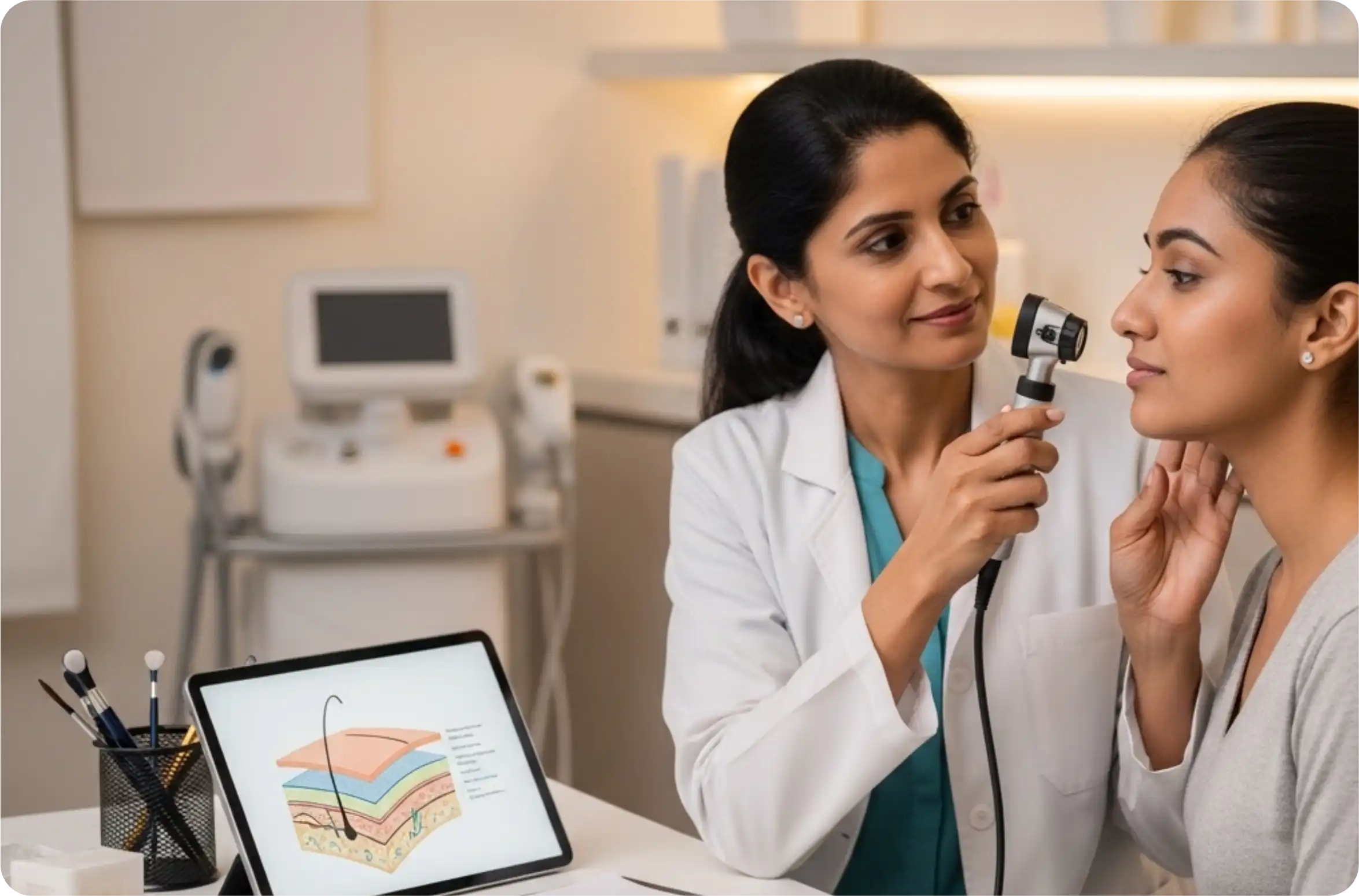
Dermoscopy & Videodermoscopy
Non-invasive tools are particularly useful for early differentiation between benign and potentially malignant skin lesions, allowing a detailed examination far beyond what the naked eye can pick up and saving patients from unnecessary biopsies in many cases.
Trichoscopy
Trichoscopy is a dedicated diagnostic technique for evaluating hair and scalp disorders, helping to distinguish between different types of alopecia and guiding treatment decisions more accurately than clinical examination alone.
Laser Systems
The department runs multiple laser platforms covering different clinical needs. These include laser hair reduction for long-term results, Q-switched lasers for pigmentation disorders and tattoo removal, and fractional lasers for acne scar treatment, skin resurfacing, and rejuvenation.
Phototherapy Units
Narrowband UVB and PUV therapy units are available for managing psoriasis, vitiligo, and other chronic inflammatory dermatoses and are an effective treatment option for conditions that don't respond well to topical therapy alone.
Radiofrequency & Electrosurgical Devices
These devices are used for skin tightening, scar management, and precise removal of benign skin lesions, offering minimal downtime and excellent cosmetic outcomes.
Digital Imaging & Documentation Systems
High-resolution imaging captures baseline photographs for documentation and tracks treatment response over time, which is especially useful for conditions like vitiligo, psoriasis, and pigmentary disorders where visual comparison across visits is important.
Patch Testing Facilities
Standardised patch testing identifies specific allergens in patients with suspected allergic contact dermatitis, allowing for targeted management rather than broad avoidance advice.
Microneedling & PRP Systems
Advanced devices for collagen induction therapy and hair restoration, using the body's own healing mechanisms to deliver gradual, natural-looking improvement.
Procedures
Management of Acute and Chronic Skin Disorders
The OPD handles the full range eczema, psoriasis, urticaria, autoimmune skin diseases, infections, and pigmentary conditions are among the most frequently seen. Treatment plans are adjusted at follow-up visits based on how the patient is responding, and patients with long-standing chronic conditions have structured review schedules rather than being seen only when they flare up.
Pediatric Dermatology
Children present differently from adults, and skin conditions in neonates, infants, and older children often have distinct triggers, presentations, and treatment considerations. The dedicated pediatric dermatology service ensures these patients are assessed with age-appropriate clinical judgment and management.
Hair and Scalp Disorder Management
Whether it's androgenetic alopecia, alopecia areata, or scalp psoriasis, hair loss conditions are assessed using trichoscopy and clinical examination before a treatment plan is put together. This matters because the right treatment depends heavily on the correct diagnosis, and many hair conditions are mismanaged when that step is skipped.
Skin Biopsies and Lesion Excision
Punch and excisional biopsies are performed in the department's procedure room for diagnostic confirmation of inflammatory dermatoses, suspected malignancies, and unclear clinical presentations. Excision of both benign and malignant skin lesions is carried out with coordination with Pathology for histopathological reporting.
Nail Surgeries and Vitiligo Surgical Procedures
Nail procedures, including avulsion and biopsy, are performed for chronic nail conditions. Surgical options for stable vitiligo, including punch grafting and split-thickness skin grafting, are available for patients where medical management hasn't achieved adequate repigmentation.
Cryotherapy, Electrocautery and Radiofrequency Ablation
Liquid nitrogen cryotherapy handles warts, molluscum, keratoses, and keloids effectively in an OPD setting. Electrocautery and radiofrequency ablation are used for benign skin lesions and scar management, with precise tissue targeting and minimal surrounding damage.
Chemical Peels and Laser Therapies
Chemical peels are used for acne, post-inflammatory pigmentation, and general skin rejuvenation. Laser treatments address scars, pigmentation, vascular lesions, and tattoo removal with the specific laser platform selected based on the skin type and the target condition rather than a one-size approach.
Botulinum Toxin and Dermal Fillers
Botulinum toxin injections manage dynamic wrinkles and hyperhidrosis. Dermal fillers restore volume and contour in areas affected by age-related fat loss or structural changes, with results assessed at follow-up to guide any further treatment.
Microneedling and PRP Therapy
Microneedling combined with platelet-rich plasma is used for acne scars, skin texture improvement, and hair restoration. The combination leverages both mechanical collagen stimulation and the growth factors in the patient's own plasma for gradual, sustained results.
STI Diagnosis and Management
Sexually transmitted infections, including syphilis, gonorrhoea, genital herpes, HPV-related conditions, and Chlamydia are diagnosed through clinical assessment backed by appropriate laboratory investigations. Treatment follows current national guidelines, with partner notification counselling provided as a routine part of management.
Confidential and Sensitive Care
Venereology consultations are conducted with full attention to privacy and confidentiality, allowing patients to be open about their concerns without fear of judgment, an essential part of getting accurate histories and ensuring treatment adherence.
Diagnosis and Multi-Drug Therapy
Leprosy diagnosis involves skin examination, sensation testing, and nerve palpation, with slit-skin smear and biopsy confirming classification when needed. MDT regimens follow WHO protocols, with treatment monitored across the full prescribed duration.
Lepra Reaction Management and Disability Prevention
Lepra reactions, both Type 1 and Type 2, are monitored actively during treatment, with corticosteroids or thalidomide used under supervision when reactions occur. Disability prevention through regular nerve function assessment, protective footwear advice, and physiotherapy coordination is an ongoing part of leprosy care, not an afterthought once MDT is complete.