Microbiology

Home

Speciality

Microbiology

The department of microbiology is a key player in the healthcare system by providing accurate microbiological diagnosis and state-of-the-art laboratory services to support patient care, medical education, infection prevention and clinical research. As one of the key diagnostic departments in modern healthcare, the department plays an important role in the identification, monitoring and control of infectious diseases while reinforcing evidence-based clinical decision-making.

The department combines academic excellence with state-of-the-art diagnostic facilities in the fields of bacteriology, virology, mycology, parasitology, immunology and molecular microbiology. The department combines sophisticated technologies, standardised laboratory practices and clinical expertise to deliver timely, accurate and clinically relevant reports for a broad range of infectious conditions. 

The department also actively supports infection control programs in hospitals, antimicrobial stewardship programs, outbreak surveillance, and interdisciplinary research efforts. The Department of Microbiology remains dedicated to safer health care delivery and improved patient outcomes with a clear emphasis on quality assurance, biosafety and patient-centred diagnostics. 

Key Differentiators

Integrated Academic and Diagnostic Environment 

One of the great strengths of the Department of Microbiology is the integration of academic teaching and advanced diagnostic microbiology services. The department provides a stimulating teaching environment for undergraduates, postgraduate trainees and allied health professionals through practical demonstrations, seminars, laboratory teaching and case-based discussions. This combination of education and clinical diagnostics improves theoretical understanding and practical laboratory skills and also ensures continuous academic progress and professional growth.
 

Strong Clinical Partnerships 

One important feature of the department is close collaboration between microbiologists and clinical departments. Close communication with physicians, surgeons, intensivists and infection control teams helps to ensure accurate interpretation of laboratory findings and patient-centric management. This approach improves the diagnostic accuracy, rational antimicrobial use and timely clinical intervention in serious infections.

Leadership in Infection Control and Surveillance 

The department also participates in infection control programs for hospitals, outbreak detection, environmental surveillance, and infection prevention strategies. Continuous monitoring of hospital-acquired infections and trends in microbial resistance can improve patient safety and reduce healthcare-associated infections. The department also plays a key role in implementing infection control guidelines, conducting surveillance audits and educating health care personnel on biosafety and infection prevention practices.

Surveillance and stewardship of antimicrobial resistance 

Antimicrobial resistance is a big global healthcare challenge, and the department plays an important role in stewardship work through susceptibility testing, antibiogram preparation, and resistance pattern monitoring. It helps keep track of how microbes behave, and you know, supports better decisions along the way. The department assists clinicians in choosing appropriate antimicrobial therapy based on evidence-based microbiological data, thereby minimising unnecessary use of antibiotics and delaying the emergence of resistant organisms.
 

Quality and Biosafety Commitment 

Standardised laboratory procedures, biosafety standards and quality assurance protocols provide reliable and reproducible diagnostic results. Each specimen is processed following standard laboratory procedures to ensure diagnostic accuracy and patient safety. Certified biosafety infrastructure, appropriate specimen handling systems and continuous quality monitoring further improve laboratory performance and operational safety.
 

Research and Scholarship 

The department encourages interdisciplinary research activities and academic conversations on infectious diseases, immunology, epidemiology, and public health. It really promotes those cross-cutting, sort of connected themes together, even if it feels a bit unsystematic at times. Regular teaching programs, seminars, journal clubs and case discussions can help students as well as healthcare professionals to keep abreast of changing microbiological practices and emerging infectious threats. 

Advanced Technologies

Advanced Microscopy & Staining Systems

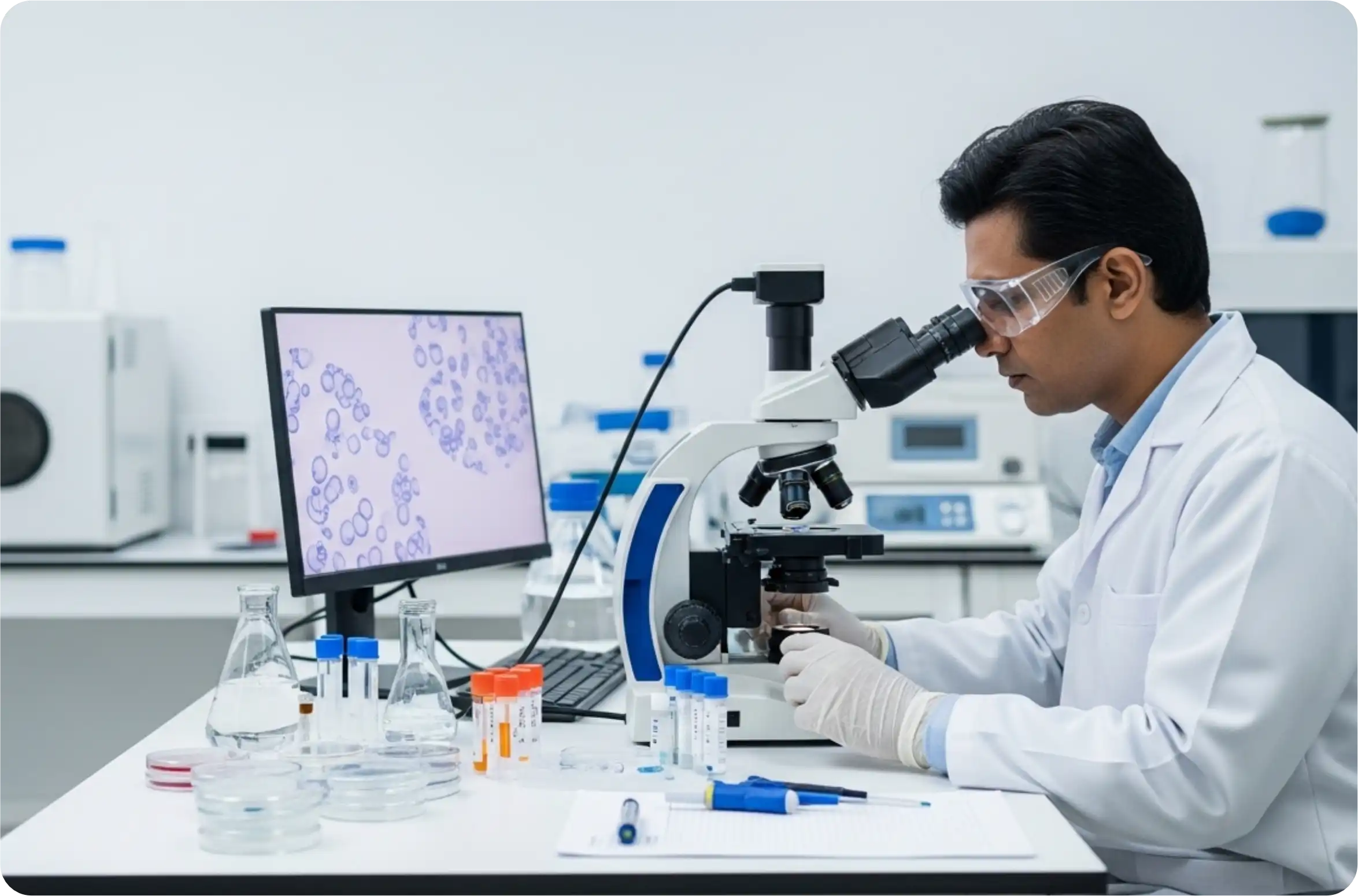
High-resolution microscopy combined with specialised staining techniques (Gram, ZN, KOH, and others) allows direct visualisation and preliminary identification of bacterial, fungal, and parasitic organisms from clinical specimens. This forms the first and often fastest step in narrowing down an infectious diagnosis before culture results are available.

Automated Bacterial Culture & Pathogen Identification

Automated culture systems process specimens consistently and flag positive results faster than conventional manual methods, reducing the time between sample collection and organism identification. Once growth is detected, automated identification platforms characterise the pathogen with a level of precision that supports confident clinical decision-making.

Automated Antibiotic Susceptibility Testing

Susceptibility testing is performed through automated platforms that generate minimum inhibitory concentration data and resistance profiles against a broad panel of antimicrobials. These results directly inform the antimicrobial stewardship programme and help clinicians shift from empirical therapy to targeted treatment.

Automated Blood Culture System

Continuous automated monitoring of blood culture bottles detects microbial growth in bloodstream infections significantly earlier than conventional incubation methods. Early flagging of positive blood cultures is critical in sepsis management, where delays in appropriate antibiotic therapy directly affect patient survival.

ELISA & Immunodiagnostic Platforms

Enzyme-linked immunosorbent assay platforms support serological diagnosis of viral, bacterial, and parasitic infections by detecting specific antibodies or antigens in patient samples. These platforms handle high sample volumes efficiently and are central to screening programmes, outbreak investigation, and chronic infection monitoring.

PCR & Real-Time PCR (RT-PCR)

Molecular detection using PCR and RT-PCR identifies infectious agents directly from clinical specimens, with sensitivity that culture-based methods cannot match, especially for fastidious or slow-growing organisms. This capability is especially valuable for viral respiratory infections, tuberculosis confirmation, sexually transmitted infections, and emerging pathogen surveillance.

Dedicated Mycology & Parasitology Facilities

Separate dedicated workspaces for fungal and parasitic investigations ensure that specialised culture media, staining protocols, and incubation conditions specific to these organism groups are maintained without the risk of cross-contamination. This separation enables accurate diagnosis of conditions that general laboratory settings frequently miss or delay.

Biosafety Cabinets & Specimen Handling Infrastructure

Certified Class II biosafety cabinets provide a contained environment for processing infectious specimens, protecting both laboratory personnel and the integrity of the samples they handle. Structured protocols for specimen reception, labelling, and transport work with the physical infrastructure to ensure safety at every stage of the diagnostic process.

Laboratory Information System (LIS)

Every specimen entering the department is tracked digitally from receipt through to final report, with the LIS managing workflow allocation, turnaround monitoring, and result communication to clinical teams. Structured data management also feeds into resistance pattern surveillance and infection control reporting at the institutional level.

Procedures

A wide range of clinical specimens, including blood, urine, stool, sputum, bronchoalveolar lavage, pus, cerebrospinal fluid, soft tissue samples, body fluids and swabs, are routinely processed for microbiological examination. The proper handling and analysis of specimens will result in the accurate detection of pathogens and clinically meaningful interpretation.
 

The direct microscopic examination continues to be one of the basic procedures in microbiological diagnosis. Routine specialized stains such as Gram stain, Ziehl-Neelsen (ZN) stain and KOH mount are done for rapid identification of bacteria, fungi and acid-fast organisms. 

These procedures are useful in obtaining preliminary diagnostic information and starting early treatment while waiting for culture results.
 

Isolation and identification of bacterial, fungal and parasitic pathogens from clinical samples: culture techniques. Automated and conventional techniques are used to correctly identify microorganisms and determine their clinical significance. 

Accurate culture-based diagnosis is essential for selecting appropriate targeted therapy and for understanding infectious disease epidemiology.
 

Antimicrobial Susceptibility Testing (AST) is routinely conducted to ascertain the sensitivity or resistance of microorganisms to various antibiotics. The department also provides detailed antibiograms to monitor the trends of resistance within the hospital environment. 

These procedures represent useful tools for antibiotic stewardship programs and contribute to the promotion of rational antibiotic prescribing.

Blood culture processing is an important procedure in the diagnosis of septicemia and bloodstream infections, Automated blood culture systems are valuable for prompt detection of microbial growth, enabling rapid identification and treatment of life-threatening infections. 

Early reporting of blood culture results is particularly important in critical patients and intensive care settings.
 

The department is also involved in extensive serological diagnosis of a variety of infectious diseases. Serological tests identify specific antibodies or antigens. They are especially useful in viral diseases, immune-mediated diseases, and epidemiological studies. 

These tests facilitate early diagnosis, disease monitoring and public health investigations.
 

The detection of infectious agents is rapid, sensitive and highly specific using molecular diagnostic procedures like PCR and Real-Time PCR (RT-PCR). These techniques are useful in diagnosis of fastidious organisms, monitoring viral load, detection of antimicrobial resistance genes and outbreak investigations. 

Molecular testing significantly reduces the turnaround time of the diagnosis and improves the accuracy of infectious disease diagnosis.

The department actively does infection surveillance activities, also environmental microbiological monitoring, with the idea of catching where hospital acquired infections might come from and to make sure we stay in compliance with infection control standards.
Routine surveillance may assist in the preservation of patient safety, reduction of healthcare associated infections and improvement of hospital hygiene practice overall.

Hands on training is an important part of the department’s activities. Students and trainees learn practical skills in specimen collection, staining techniques, culture techniques, antimicrobial susceptibility testing and clinical interpretation of microbiological findings. 

This training increases laboratory competence and knowledge of diagnostic microbiology in clinical practice.
 

Join our newsletter today to get the latest updates and easily manage your data more efficiently!
Newsletter Subscribe